Adversary AI: The New Frontier of Cyberattacks
A blog on how adversaries are weaponizing AI to create new, highly effective attack techniques
Artificial Intelligence (AI) isn’t just for writing clever emails or generating cool images; adversaries are now weaponizing it to make cyberattacks faster, smarter, and infinitely more convincing. Forget standard automated scripts; ADVERSARY AI is enabling entirely novel, subtle techniques that are devastatingly effective. Think about how much OSINT (Open Source Intelligence) data an adversary can process and pattern-match with AI.
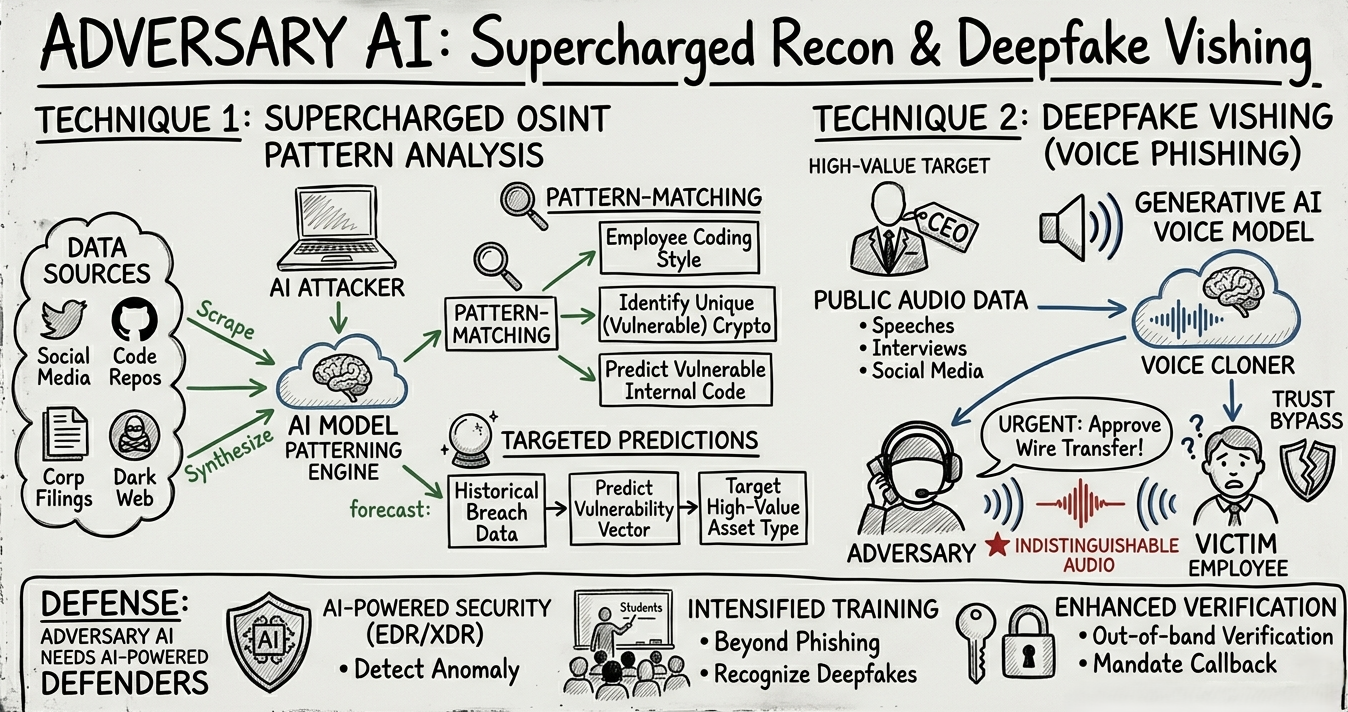
Technique 1: OSINT Pattern Analysis
Standard OSINT is slow, human-intensive work. Adversaries can now train AI models to scour public and dark web data – social media profiles, forum posts, code repositories, corporate filings, etc. – not just for obvious data points, but for subtle patterns of data.
Pattern-Matching: Instead of finding one data leak, imagine a model that automatically connects an employee’s previous coding pattern in a public repo to a specific, unique (and vulnerable) cryptographic implementation detail in a different public repo for a different company, then predicts similar patterns in the target organization’s internal codebases.
Targeted Predictions: Models can analyze historical pattern data of data breaches across industries and predict the next likely vulnerability vector or high-value target type, allowing for extremely targeted reconnaissance impossible with simple tools. This isn’t just data gathering; it’s massive-scale data synthesis for highly customized, unexpected reconnaissance.
Technique 2: Deepfake Vishing (Voice Phishing)
Phishing emails are getting more convincing, but deepfake technology takes social engineering to a truly terrifying new level: Deepfake Vishing. Adversaries can now use AI to generate highly convincing, realistic voice deepfakes.
How it Works: Attackers train a model on public audio of a high-value target (CEO, CFO, key executive), often from diverse sources like public speeches, interviews, and even social media videos. Generative voice models can then clone the specific vocal characteristics, intonations, and mannerisms to create custom, indistinguishable audio.
The Attack: A standard vishing attack relies on script and high-pressure tactics. A deepfake vishing attack uses the cloned voice to build immediate, undeniable trust. Imagine receiving an urgent call from your “CEO” asking for an immediate, unusual wire transfer or critical access credential, sounding exactly like them. No suspicious typos to spot, no generic greetings – just a seemingly authentic, high-authority request. Traditional voice authentication and simple skepticism are completely bypassed.
Defense: Adversary AI Needs AI-Powered Defenders
Adversaries are leveraging AI, so defenders absolutely must too.
AI-Powered Security (EDR/XDR): Employ robust, modern EDR/XDR (Extended Detection & Response) solutions that themselves use AI/ML to detect anomalous behavior and patterns impossible to manually code. They can identify subtle shifts in user behavior, network traffic patterns, and process executions that might signal AI-driven reconnaissance or automated evasion.
Intensified, Realistic Training: Employee training must go beyond identifying standard phishing emails. Teach employees about deepfake possibilities and highly personalized OSINT. Make them deeply skeptical of any unexpected, high-risk request, particularly involving financial transactions or sensitive access, regardless of how convincing the source seems.
Enhanced Verification & Authentication: Strengthen multi-factor authentication (MFA) and, crucially, implement strict out-of-band verification protocols. For any voice-based or unusual request for sensitive actions, mandate verification via a different, trusted communication channel (e.g., calling back on a known, trusted corporate number, separate secure messaging).